No Preschool Post Today

I really need to catch up on the laundry! If you need a daily dose "little one love," Dawn has an inspiring post on handcrafts for wee ones. And Donna Marie is talking about toys, Montessori, and art for the younger set. Kim's sidebars have an abundance of preschool resources and she's got some pictures and ideas of her own, too. Theresa's caught the "making manipulatives bug"  and she's on a roll (she's been doing some redecorating at her blog--very pretty!). I've listed all the Real Learning preschool posts on a sidebar list to your right.  Finally, if you are bubbling over and eager to share, they are chatting about preschool and all these posts and some new ideas too the 4reallearning message board. And I'll be back with some thoughts on teaching the faith to our littlest angels just as soon as I climb Mt. Never-rest!

Keeping my eyes on the goal...

This has been my summer of education.  Christian and Nicholas have both challenged me to learn anew about special needs and how best to meet them.  They've insisted that I look carefully at their sweet faces and study their very beings.  And they've inspired me to look far ahead (as if we could really do that) and wonder what will come.  Mary Ellen has gently called me back from my musing and my worry and reminded me that the real goal is the same whether your child has special needs or not.  When you click to visit the Bonny Blue House, please offer a prayer for the dear mother who lives there.  She's carried twins heroically, almost all the way to term and will deliver a boy and a girl any moment!

Number Fun

This post is part of the preschool series.

Part one is here.

Part two is here.

Part three is here.

Preschool math really is all fun and games.  Learning to count, learning one to one correspondence, even beginning addition and subtraction never need be tedious.  And at this stage of the game, math really can be manipulated all the time. 

Starting at the bottom of the shelf, a collection of Montessori geometric solids can be presented using the Three Period Lesson. After it's been presented, the child can choose that particular work on her own any time.  Learning the names and properties of solids is simple and sensorial.

Next up is the hundred board.This is used by placing numbered tiles on the appropriate squares. Later, skip counting can be represented here as well.Katie can’t really do it alone, but Nicholas and/or Stephen are generally eager to help her.I got mine at a certified Montessori school.It’s a little worn and they were required to replace it with a pristine one in order to be re-certified. It was free!If you want to acquire Montessori materials for you home, it’s worth cultivating a relationship with a school directress.

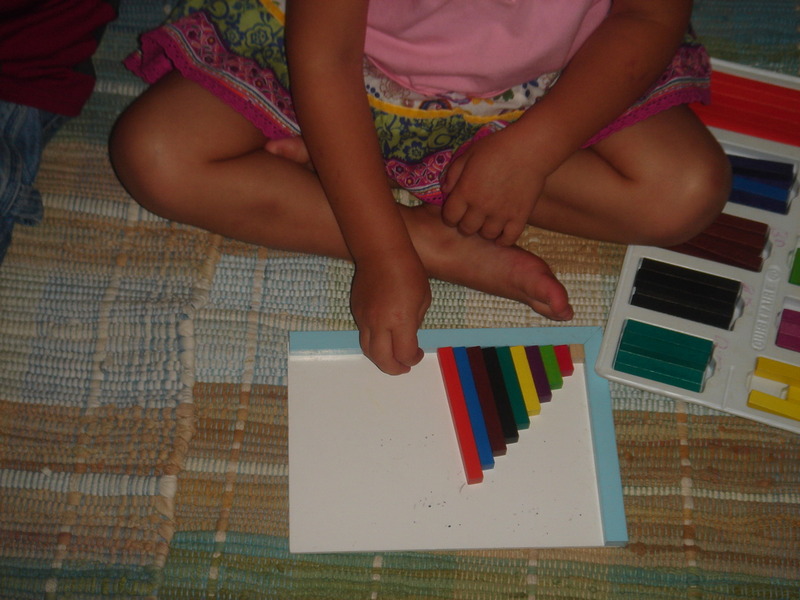
My hands down favorite hands-on material is Cuisenaire rods.No question, these are versatile, brilliant materials. First a little history from the Cuisenaire UK website :

One of [Georges Cuisenaire's] inventions was a set of coloured wooden rods and some similarly coloured cardboard materials. He used these to teach arithmetic and found he achieved something rare with this subject. The standard of the results he obtained greatly improved and his pupils enjoyed and understood the work they did. Nevertheless this invention remained almost unknown outside the village of Thuin for about 23 years until a providential meeting of this teacher with another resulted in the use of this invention spreading to classrooms throughout the world. And in the 13 years since that meeting the proven success of Cuisenaire’s rods has made his name a household word.

Dr. Caleb Gattegno met Cuisenaire during 1953 It seemed, he wrote some years later as if all his previous work as an educationalist had been in preparation for that moment. For many years he had been a leading figure in the movement to bring improvements to mathematics teaching at the primary and secondary school levels. His firm belief that special teaching technniques coupled with the development of a hitherto unexploited intellectual ability in young children could produce such improvements, had already been demonstrated with encouraging results where his influence had been felt, In Cuisenaire’s rods he saw what many had already seen but found at once what few had been sufficiently prepared to understand Physically the rods behaved in the way numbers behave, providing the learners wnth an algebraic model for the study of mathematics. But perhaps more important still, he realised that they provided teachers with a means for making the lesson a personal investigation of mathematics for every pupil.

And so it is—personal guided discovery of all sorts of mathematics principles using colored wooden rods. The rods are stored on the shelves in sorting trays and I provide rod racks there as well. I present a lesson or two a week and then encourage them to practice the work daily. We start with The Cuisenaire Rod Alphabet Book.  From there, favorite resources for lessons include The Cuisenaire K-2 Super Source Book and Idea Book for Cuisenaire Rods. Eventually, this “play” leads to the use of Addition and Subraction with Cuisenaire Rods and Mathematics Made Meaningful.  Cuiseanire really has an entire curriculum of its own, or we might switch to Miquon, combined with Touchmath.  It really depends on how a particular child "sees" math.

On days when I don't present a Cuisenaire rods lesson, we might spend some time together Exploring with Color Tiles or creating with Pattern Blocks.  Both of these activities are almost guaranteed to draw an older sibling.

Early geometry is tons of fun.  My children can be happily involved with geoboards for long stretches of quiet concentration. I don't often do formal "lessons" here, but encourage lots of creative exploration.  And they pair up:  one child can create an orginal design and another can try to copy it.

The balance is a wonderful tool to use for several years.  It's amazing what you can learn using this:  time, money, measurement, addition, subtraction, Roman numerals, even fractions and decimals! Very cool "toy!"

Base Ten Blocks can be used with base ten lesson plans and they can also as a suitable substitute for Montessori Golden Bead material.  We have a set that snaps together.

From my oldest son's blog...

I only have a year left before I'm on my own." I can't help but wonder, "Did I do everything right?" or, "Am I going to function on my own or just implode?"

That's funny; I sometimes wonder the same thing, though not nearly as often as I used to.  You see, dear boy, you don't have to do everything right and neither do I.  We just have to get the important things right:  faith and family. The rest is just details. And you will never be on your own, never truly alone, despite the way it looks right now.  You will always have those important things--your faith and your family--with you wherever you go and whatever challenges face you.  That is the real fruit of a truly happy childhood: you get to be a grownup knowing that God loves you without end and that we do, too...It's all good.